Mirror and Mosaic is an independent guide to Queen Califia's Magical Circle, the sculpture garden by Niki de Saint Phalle in Escondido, California. Wikipedia's article on the garden describes an enclosed circle entered through a mosaic maze, with sculptures and native planting in its courtyard. That combination gives this guide its starting point: an artwork can be considered as a set of figures, a shaped space, a collection of materials and a place within a landscape.
The pages follow those strands without requiring a background in art history. A reader can begin with the garden's overall layout, then follow the queen, the wall or the surrounding figures into closer discussions. Another route begins with the artist and follows her public works towards Escondido. The legend behind Califia's name offers a different entry, through literature and the naming of California. Each route returns to the same question: what becomes clearer when the work is viewed in context?
A garden described in words
The garden guide moves from the approach and outer boundary towards the plaza. Its companion pages consider the central queen and eagle, the egg-shaped fountain, the totems and the wall with its maze. These are descriptive readings, intended to make the relationships between parts easier to follow. A figure that seems separate when named on a page may also be part of a larger arrangement. Shape, position and surface can be considered together without assigning a fixed meaning to every detail.
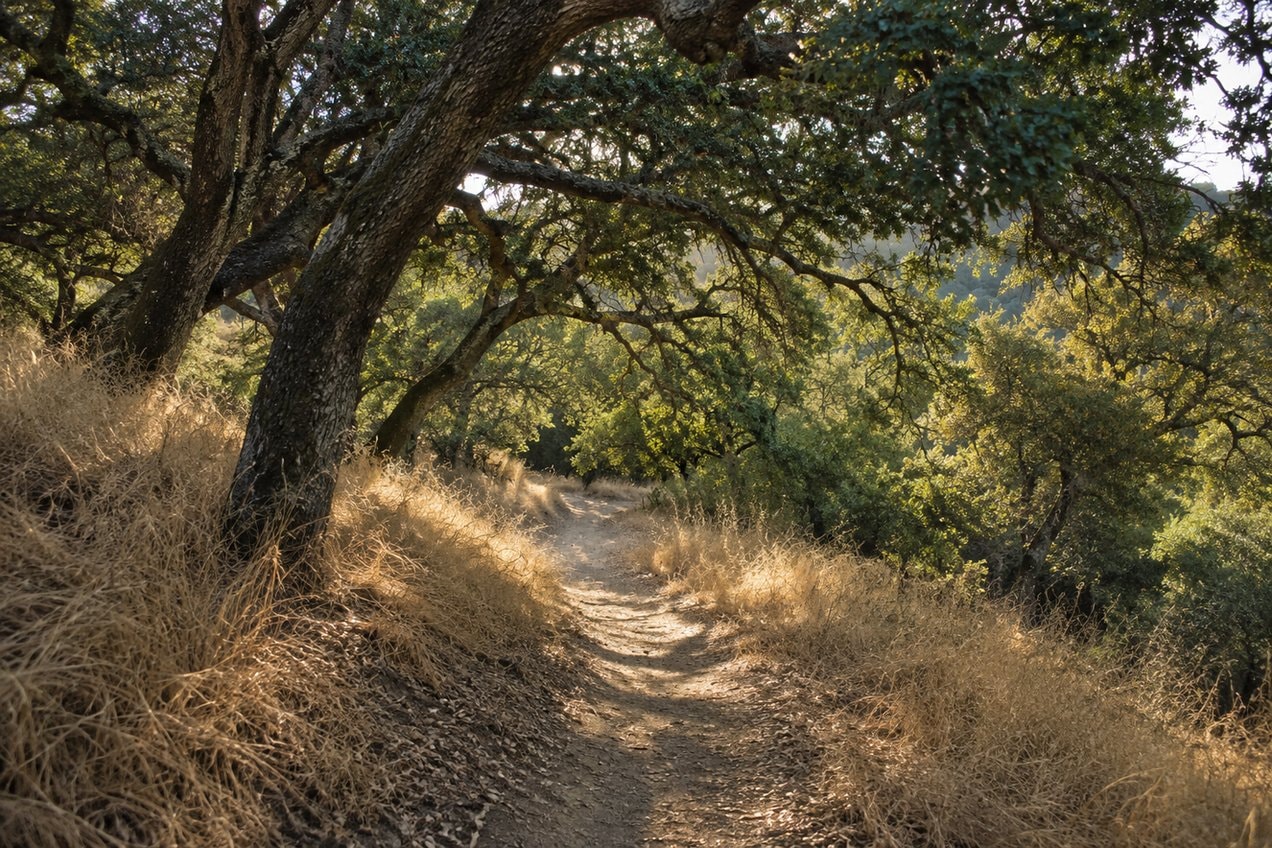
Images on this guide concern landscape, materials and an ordinary day outdoors. The sculptures themselves are described in prose. That leaves attention with the published descriptions and with the questions they raise. How does an entrance shape the encounter with a courtyard? How does a reflective surface differ from a pebble facing? Where does a symbolic image become a building-like form? These are useful questions for a student as well as for someone planning an unhurried look at the artwork.
Art within a park
Wikipedia's account of Kit Carson Park distinguishes its developed areas from land preserved as natural habitat. The landscape pages place the circle within that wider park setting and introduce the surrounding region's vegetation. They also distinguish a description of a plant community from an identification of a plant at the garden. An oak, a shrub and a patch of grass can matter to the way a place is read, without turning a general landscape guide into a plant inventory.
The artist pages keep attention on Niki de Saint Phalle's career, works and materials. The legend pages consider a literary queen and a geographical name. The making pages move from models and structure to the mosaic surface, while the care pages ask what it takes to keep outdoor public art available. Those subjects belong together, but they answer different questions. A material description cannot establish a symbol's meaning, and a historical account cannot settle the practical details of an outing.
Public art brings a material question and a civic question into the same view. Wikipedia describes the city partnering with the artist to make and maintain the garden. The pages on care and funding take that continuing responsibility seriously. A discussion of a glittering surface can lead to a question about replacing a lost piece; a discussion of ownership can lead to a question about long-term upkeep. Those connections give the artwork a life in public beyond the account of its design.
From reading to an outing
The visiting pages treat access as something to check with the city. This guide offers context for that check rather than a schedule. Its walking reference is written for adults and covers heat, sun, feet and joints through named health references and clearly attributed research. It gives no walking target and makes no promise about the effects of a park visit. Rest, shade and a pace that leaves room for looking can remain part of an ordinary outing.
The grouped links below allow the guide to be used in either direction: from the whole garden to a particular detail, or from a subject such as mosaic, myth or public-art care back to the circle. There is no single required reading order. The longer garden and artist accounts provide broad context; the narrower pages give room to a material, a feature or a practical question. The notice explains the guide's relationship to the organisations responsible for the artwork.
Explore the guide
The garden
- The garden guide — Follow the layout from boundary to courtyard.
- Califia, the eagle and the egg — Read the central group and its sheltered space.
- The totems — Consider the surrounding figures without assigning invented identities.
- The wall and maze — Look at enclosure, surface and entry.
- The native landscape — Place the circle within the wider park.
The artist
- Niki de Saint Phalle — Follow a career through public works and materials.
- Finishing the garden — Read a quiet account of its completion.
- Works around San Diego County — Put the garden beside the artist's other regional works.
- Gardens and public spaces — Compare ways of encountering art outdoors.
Legend and materials
- Califia's legend — Separate a literary island from the place name it helped shape.
- Eagles, serpents and totems — Approach symbolic influences with care.
- Mirror, glass and stone — Learn the vocabulary of a mosaic surface.
- Making the garden — Follow models, structure and hand-set surfaces.
Park and care
- Looking after mosaic — Consider specialist care, weather and supervised access.
- Paying for upkeep — Distinguish creating public art from caring for it.
- Kit Carson Park and Escondido — Understand the setting before checking practical access.
- Visiting thoughtfully — Bring attention to fragile materials and changing access.
- Heat, sun, feet and joints — Read an adult reference for the walking part of an outing.
About the guide
- About Mirror and Mosaic — Read the guide's purpose and limits.
- Terms and privacy — See how this reference handles use and privacy.
- Mirror and Mosaic — Return to this overview and grouped index.
Mirror and Mosaic is an independent guide to Niki de Saint Phalle's sculpture garden in Escondido, California. It is not affiliated with, endorsed by, or connected to the City of Escondido, the Niki Charitable Art Foundation or the garden's volunteer docents, and it does not speak for any of them. It sells nothing, takes no bookings and accepts no donations. The sculptures are protected by copyright and this site shows no pictures of them. For opening times and visiting information, see the City of Escondido's page for the garden at escondido.gov.